
United States Regiments & Batteries * United States Colored Troops
The 4th Regiment of United States Colored Troops lost 3 officers and 102 enlisted men killed or mortally wounded and 1 officer and 186 enlisted men to disease during the Civil War.
|
1863
|
|
| July 15 -September 1 | Organized at Baltimore, Maryland |
| October 1 | Moved to Fort Monroe, Virginia then moved to Yorktown, Virginia |
| October-May | Duty at Yorktown attached to 2nd Brigade, United States Forces, Yorktown, Virginia, 18th Corps, Dept. of Virginia and North Carolina |
| October 4-9 | Expedition from Yorktown to Matthews County |
|
1864
|
|
| February 6-8 | Wistar’s Expedition against Richmond |
| February 8 | New Kent Court House |
| March 1-4 | Expedition to Bottom’s Bridge in aid of Kilpatrick’s Cavalry |
| March 9-12 | Expedition into King and Queen County |
| March 17-21 | Expedition into Matthews and Middlesex Counties |
| April | Attached to 2nd Brigade, Hincks’ Colored Division, 18th Corps |
| May 4-June 15 | Butler’s operations south of the James River and against Petersburg and Richmond |
| May 4 |
Skirmish at Bermuda Hundred |
| May-June | Duty at Spring Hill on the Appomattox. Built Fort Converse on the Bermuda Hundred line. |
| May 20 |
Attack on Fort Converse |
| June 15-18 |
Before Petersburg |
| June 16 – December 7 |
Siege operations against Petersburg and RichmondAttached to 2nd Brigade, 3rd Division, 18th Corps |
| July 30 |
Mine Explosion, Petersburg, Battle of the Crater |
| September 7 |
Dutch Gap |
| September 28-30 |
Battle of Chaffin’s Farm, New Market HeightsThe regiment attacked Confederate fortifictions under heavy fire. Color bearer Sergeant Alfred B. Hilton of Company H, carrying the national colors, took the regimental colors from another color bearer who had been wounded. Hilton was then mortally wounded, shot through the leg, and called “Boys, save the colors!.” Corporal Charles Veale of Company D took the regimental colors and Sergeant Major Christian Abarham Fleetwood took the national colors from Veale before either could touch the ground. They continued forward until it became plain that the charge would not succeeded. When the attackers withdrew to the reserve line Fleetwood waved the flag and rallied men from the regiment to continue the fight. All three men were awarded the Medal of Honor:
|
| October 27-28 |
Battle of Fair Oaks |
| December 7-27 |
1st Expedition to Fort Fisher, North CarolinaAttached to 2nd Brigade, 1st Division, 25th Corps |
|
1865
|
|
| January 7-15 |
2nd Expedition to Fort Fisher, North CarolinaAttached to 2nd Brigade, 3rd Division, 25th Corps |
| January 15 |
Assault and capture of Fort Fisher, N. C. |
| January 19 |
Sugar Loaf Hill |
| February 11 |
Sugar Loaf Battery |
| February 18-20 |
Fort Anderson |
| February 22 |
Capture of Wilmington |
| February 22 |
Northeast Ferry |
| March 1-April 26 |
Campaign of the CarolinasAttached to 2nd Brigade, 3rd Division, 10th Corps, Dept. of North Carolina |
| March 6-21 | Advance on Goldsboro |
| March 21 | Occupation of Goldsboro |
| March 23-24 | Cox’s Bridge |
| April 9-18 | Advance on Raleigh |
| April 14 | Occupation of Raleigh |
| April 26 |
Bennett’s HouseSurrender of Johnston and his army. |
| October-May | Assigned to the Northern Defenses of Washington under the command of Lieutenant Colonel Augustus Boernstein and Major Wareham C. Hill.
The regiment was stationed in: Fort Sumner: Companies A & I |
| 1866 | |
| May-August | Assigned to the Dept. of North Carolina |
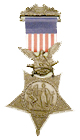 Sergeant Hilton, “When the regimental color bearer fell, this soldier seized the color and carried it forward, together with the national standard, until disabled at the enemy’s inner line.”