
| By August 1 Jubal Early’s Raid on Washington was over. In June he had been given command of the Second Corps of the Army of Northern Virginia – Jackson’s old command – and was sent to the Shenandoah Valley. It was hoped he could repeat the magic of 1862 when Jackson and his “foot cavalry” drew many times their strength in Union troops away from McClellan’s drive on Richmond.Early was to make use of the geography of the Shenandoah Valley to threaten Washington and southern Pennsylvania. He would also try to hold the breadbasket of Virginia and protect critically needed supplies for Lee’s hungry army.Early had already succeeded in one of his goals. As he neared the gates of Washington in July on a daring raid Horatio Wright’s Sixth Corps was withdrawn from the Petersburg front and sent to Washington. Two divisions of the Union Nineteenth Corps were in the process of being transferred from Louisiana to Virginia when they, too, were diverted to stop Early. Two of the Army of the Potomac’s three cavalry divisions are now also on their way north.The success comes with a cost. All these troops have one goal – to destroy Early’s army, and to make sure the Shenandoah Valley can never again be used by the Confederacy. |
 Confederate Lieutenant General Jubal A. Early |
|
| August | ||
| August 6 | Union Major General Philip Sheridan was assigned command of the new Middle Military Division, which included the Middle Department and the Departments of Washington, Susquehanna, and West Virginia. His field army formed around Crook’s Army of West Virginia, Wright’s Sixth Corps and two cavalry divisions from the Army of the Potomac, and two divisions from the 19th Corps, which was returning from Louisiana and had been intended as reinforcements for the Petersburg fighting.Sheridan’s force would be known as the Army of the Shenandoah. His objective was to destroy Early’s Confederate Army of the Valley. Knowing of the heavy Union reinforcements heading toward Early, Robert E. Lee sent Lieutenant General Richard Anderson to the Valley with Kershaw’s Infantry Division, Fitz Lee’s Cavalry Division and Cutshaw’s Battery. His reasoning was if a soldier in the Shenandoah could tie down twice as many Union troops, he would send as many men there as he could possibly afford. |
 Union Major General Philip Sheridan |
| August 7 |
Battle of Moorefield (Oldfields)Averell’s Union cavalry attacked McCausland’s Confederate cavalry returning from the burning of Chambersburg, Pennsylvania. The Confederates were surprised in their camps at dawn, and over 400 were captured. |
|
| August 8 | Sheridan’s infantry concentrated around Halltown, while Early’s men bivouacked at Bunker Hill twelve miles to the west. | |
| August 10 | Sheridan’s army marched south 14 miles to Berryville, arriving in late afternoon. Early withdrew south to Winchester, preventing Sheridan from getting around his rear. | |
| August 11 |
Double Toll GateEarly turned back Union cavalry east of Winchester attempting to cut the Valley Pike. Both armies continued moving south. |
|
| August 12 | Early moved his men into position on Fisher’s Hill, just west of Strasburg. Sheridan’s men went into bivouac on the north side of Cedar Creek. | |
| August 13 | Sheridan made a reconnaissance to Hupp’s Hill outside Strasburg. | |
| August 14 | Concerned at reports that Longstreet had been sent to the Valley to reinforce Early, Sheridan sent Devin’s cavalry brigade to Front Royal to watch the west side of Manassas Gap. Late in the day he received a message from Grant that two divisions of infantry left the Richmond area for the Shenandoah, and Sheridan should remain on the defensive. | |
| August 15 | Sheridan sent two cavalry brigades to Front Royal to delay the expected Confederate reinforcements. At the end of day the 19th Corps marched for Winchester through the night in the pouring rain. | |
| August 16 |
Guard HillConfederate reinforcements under Richard Anderson moved north to join Early around Winchester and ran into Merritt’s Union cavalry division north of Front Royal. Union cavalry under George Custer captured over 300 Confederates in a sudden attack. The remaining Union infantry at the Cedar Creek bivouac began their retreat to Winchester at dusk. |
|
| August 17 | Ordered by Grant to act with caution and unsure of how many Confederate reinforcements Anderson was bringing north, Sheridan withdrew to Charles Town via Berryville. Early pursued to Winchester and attacked the Union rear guard at Abrahams Creek, then moved north along the Valley Pike to Bunker Hill. | |
| August 21 |
Summit PointEarly attacked the Union infantry at Cameron’s Depot with Rodes’ Division while Anderson struck the cavalry at Summit Point, north of Berryville. Sheridan continued to withdraw from Charles Town to Halltown. |
|
| August 22 | Sheridan reoccupied the defences at Halltown, while Early’s men moved into Charles Town. | |
| August 23 | For the first time in days, both armies were at rest. Reports to Sheridan indicated that as many as three infantry divisions – a third of Lee’s army – may have reinforced Early, which would greatly outnumber Sheridan’s force. Aware of the need to prevent another invasion of the North and of the upcoming elections, Sheridan reinforced his defences. In Washington, Lincoln asked his cabinet to sign an unread and sealed letter which stated his intentions should his administration lose the coming elections. | |
| August 25-26 | Early was becoming convinced that Sheridan was yet another cautious Union general. Still tasked with decoying as many Union troops as possible, he left Anderson’s reinforcements at Charlestown and moved toward the Williamsport crossing of the Potomac. He hoped to draw some or all of Sheridan’s men back into Maryland. | |
| August 26 | While an attack by two divisions of Union cavalry was driven back, Union infantry attacked and captured some Confederate defences at Halltown. Early abandoned the movement into Maryland and withdrew to Bunker Hill. | |
| August 27-28 | Early established a defensive line on the west side of Opequon Creek from Stephenson’s Depot outside Winchester north to Bunker Hill. Sheridan moved out of the Halltown defences and into Charles Town, and sent his cavalry to picket the east bank of Opequon Creek. | |
| August 29 |
Smithfield CrossingUnion cavalry were driven back from an attempted crossing of the Opequon, but a follow up attack by infantry restored the Union line along the creek. |
|
| September | ||
| September 2 – 3 | While Averell’s cavalry attacked and were driven back from the Confederate flank at Bunker Hill, Sheridan moved his infantry out of Charles Town toward Berryville. | |
| September 3 – 4 |
Battle of BerryvilleKershaw’s Confederate Infantry Division attacked Thoburn’s Division of Brevet Major General George Crook’s Army of West Virginia at Berryville. Kershaw drove in Thoburn’s flank before the rest of the Crook’s men restored the position. Overnight Early reinforced Kershaw with the rest of the army but decided in the morning that the Union defences were too tough to attack. Crook’s Army of West Virginia – also known as the 8th Corps – had fought in western Virginia for most of the war and now make up one of Sheridan’s three infantry corps. Crook had been roomates with Sheridan at West Point, and remained friends. |
 Union General George Crook |
| September 4 – 7 | Sheridan formed a body of scouts under Major Henry K. Young and Segeant Joseph McCabe. These men will operate inside Confederate lines, in Confederate uniforms when necessary. | |
| September 5 | Early pulled back to Winchester, leaving a picket line of cavalry along Opequon Creek. | |
| September 6-18 | Heavy rains drenched the Valley, making movement difficult except along the paved Valley Pike. Both armies rested. Sheridan’s intelligence had accurately told him that only Kershaw’s division has reinforced Early, and Kershaw is to be withdrawn back to Lee’s army if not needed. Sheridan planned no further action until Kershaw was withdrawn. | |
| September 14 | Anderson and Kershaw headed south from Winchester along the Valley Pike to return to Lee’s Army. They will move through Front Royal and the Luray Valley. | |
| Setember 15 | Convinced that Sheridan is timid, Early spreads his infantry out in the lower Valley. He sent a division to Martinsburg, cutting the Baltimore and Ohio Railroad. | |
| September 18 | Anderson and Kershaw left the Valley via Thornton’s Gap to return to Lee around Richmond. | |
| September 19 |
Third Battle of Winchester (Opequon)Sheridan attacked west from Berryville, hoping to catch Early’s scattered army and defeat it in detail. But delays from trying to move three army corps up the narrow Berryville canyon gave Early time to force march his scattered infantry and reconcentrate east of Winchester. The fight went on all day. Confederate General Robert Rodes and Union General David Russel were killed within a short distance of each other as the fighting seesawed back and forth.By late afternoon Crook’s two divisions outflanked the main Confederate line on the north and Union cavalry overran Early’s line north of Winchester in a thundering saber charge, the largest of the war. Early’s line collapsed and his army retreated through Winchester and south twenty miles to Fisher’s Hill. Sheridan lost 5,000 men, about 12% of his army. Early lost 3,500, but these were over 25% of his smaller force. It was the bloodiest battle fought in the Shenandoah Valley. |
|
| September 21 | Union probes against Early’s lines at Fisher’s Hill showed the position would be very costly to attack frontally. Crook proposed a flank march by his two divisions through the steep mountain terrain on the Confederate left flank. The plan was violently opposed by Sixth Corps Commander Horatio Wright but Sheridan, who was Crook’s roommate at West Point, approves.Early’s second in command, Major General John Breckinridge, was ordered to leave the Valley to resume command of the Department of East Tennessee and Western Virginia. Breckinridge was the former vice president of the United States under James Buchanan and candidate for President of the United States in 1860 (coming in second in the Electoral College behind Lincoln). He was an able combat commander who had defeated Franz Siegel at the Battle of New Market in May. He would be missed in the days to come. |
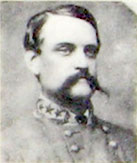 Confederate General John Breckinridge |
| September 22 |
Battle of Fisher’s HillCrook’s plan worked perfectly. While most of Sheridan’s men kept the attention of the Confederate defenders by preparing to make a frontal assault, Crook’s corps worked its way along the densely wooded mountain on the Confederate flank. In the afternoon they charged down the mountainside “like an avalanch.” The Confederate line unraveled in panic. The rest of the Union line launched their assault against rapidly emptying Confederate trenches. Compared to the Third Battle of Winchester three days before, Fisher’s Hill was almost bloodless – 30 Confederates and 51 Federals were killed, and 200 Confederates and 400 Federals wounded. Early, however, lost over a thousand prisoners, over a tenth of his army badly reduced army. Sheridan’s victory was not complete. He had sent two of his three cavalry divisions around Massanutton Mountain in a wide flanking movement that the hoped would come in behind Early’s line of retreat to New Market. But Confederate cavary blocked the attempt near Luray and it failed. |
|
| September 23 | Union cavalry pursued Early’s reteating men to north of Mount Jackson, where Wharton’s and Ramseur’s Divisions organized a rear guard. Union infantry advanced to Edinburg. After darkness Early fell back to Rude’s Hill. | |
| September 24 | Early methodically leapfrogged his army through a series of defensive positions from Rude’s Hill to south of New Market. | |
| September 25 | Early continued to fall back through Port Republic. By the end of the day his army went into camp at Brown’s Gap. Sheridan did not follow, continuing on the Valley Pike to camp around Harrisonburg. | |
| September 26 | Kershaw returned to the Valley with his division of 2,700 men and joined Early at Brown’s Gap. | |
| September 26 – October 8 |
The BurningBeginning near Staunton, Sheridan slowly withdrew down the Valley, destorying its manufacturing and agricultural capability as he went. Public buildings as well as mills and barns were burned, livestock were herded away and crops were removed or destroyed. |
|
| October | ||
| October 5 | Confederate General Rosser’s Cavalry Brigade arrived with 600 men to reinforce Early. | |
| October 6-9 | Rosser harassed Sheridan’s cavalry as they carried out the destruction of the Valley. | |
| October 9 |
Battle of Tom’s BrookTired of the Confederate harassment, Sheridan told his cavalry commander, A.T.A. Torbert, to “whip the enemy or get whipped.” When they reached Tom’s Brook, Merritt’s and Custer’s divisions of Union cavalry turned on their tormentors and made use of their superior numbers and repeating carbines to route the Confederate horsemen. They were chased twenty miles up the Valley Pike in what would come to be known as the “Woodstock Races.” |
|
| October 12 | Wright’s Sixth Corps began its march to Washington, where it was to take ship to return to Grant and the Petersburg front. | |
| October 13 |
Battle of Hupps HillEarly returned down the Valley and probed the Union camps along Cedar Creek. Thoburn’s Union infantry division advanced and clashed with Kershaw’s Confederates, with about 200 casualties on each side. Sheridan decided that sending his Sixth Corps back to Grant may have been premature and ordered Wright to return to the Union bivouac around Cedar Creek. |
|
| October 16 | Sheridan left the Army of the Shenandoah under the command of Horatio Wright to meet in Washington with Secretary of War Edwin Stanton. | |
| October 18 | Sheridan returned from his meeting with Stanton. He decided to spend the night in Winchester before heading on to the army in the morning. | |
| October 19 |
Battle of Cedar CreekEarly launched a dawn attack in a heavy fog on the sleeping Union camps. His lead column made a night march along a narrow path at the foot of Massanutton Mountain to fall on the Union left flank. Crook’s Eighth Corps took off for the rear in confusion. Emory’s Ninteenth Corps had a little more warning and is able to form a battle line, but after desperate resistance they, too were overwhelmed and headed for the rear. The Sixth Corps camps had the most warning and were able to meet the Confederate attack, although they were forced to withdraw to a series of fallback positions. But the Confederate attack began stalling out. The chaotic fighting in the early morning fog disrupted the attackers almost as much as the defenders. Many of the hungry, ragged, and barefoot Confederates took time out among the richly laden Union camps to eat and find warm clothes for the coming winter. And while several of his commanders were anxious to finish the work, Early seemed content with the damage he had done so far and believed the Union Sixth Corps would fall back without further pressure. Meanwhile Sheridan had heard the gunfire off in the distance and headed south from Winchester along the Valley Pike. As he ran into refugees from the battle heading to the rear he convinced many to turn back and follow him to “take back our camps” and “make coffee out of Cedar Creek tonight.” He reached the battlefield around mid-morning, where the Sixth Corps and the Union cavalry were still ready to fight. Sheridan took his time readying his army, reforming Emory’s corps and riding the length of the line so his men could see that he had returned. He launched his attack at 4 p.m. For an hour the fighting was severe, then the Confederate left flank began to crumble. Custer’s cavalry punched through towards the Confederate rear, and the rest of Early’s line began to shred as his men raced the Union troopers to the rear. Confederate General Stephen Ramseur was mortally wounded, and his division joined the retreat. The collapse of a bridge on the Valley Pike south of Strasburg forced anything with wheels – guns, supply wagons, ambulances – to be left behind to be captured. Early’s army headed south, pausing briefly at Fisher’s Hill and then continuing to New Market. It had fought its last battle. |
|
Aftermath – November |
||
| November 15 | Kershaw’s Division was ordered to rejoin the First Corps of Robert E. Lee’s Army of Northern Virginia outside Richmond. | |
| December | ||
| Mid-December | The three badly reduced divisions of the Confederate Second Corps returned to the Richmond front under the command of John Gordon. Early remained in command of the Valley with Wharton’s small infantry division and Lomax’s and Rossers’ cavalry divisions. | |
| January 1865 | ||
| January | Unable to forage their cavalry horses in the ravaged Shenandoah, Lomax’s Cavalry Division was sent out of the valley to the west for the winter and Rosser’s Cavalry Division disbanded the men to their homes. Echol’s Infantry Brigade was detached to the Department of Southwestern Virginina, leaving Early with two small brigades of infantry in Wharton’s Division. | |
| February 1865 | ||
| March 1865 | ||
| March 2 |
Battle of WaynesboroThe last of Early’s forces were wiped out. |
|
| Mid-March | Rosser’s Cavalry Division and McCausland’s Cavalry Brigade left the Valley to join Lee’s army around Petersburg | |
|
April 1865 |
||
| Mid-April | After Lee’s surrender Lomax’s Cavalry left the Valley to join Johnston in North Carolina. They surrendered at Greensboro. | |