
United States Regiments & Batteries > New York > 79th New York Infantry Regiment
“Highlanders”
The 79th New York Infantry Regiment enrolled 2,200 officers and men during the Civil War. It lost 198 men killed and mortally wounded, with 304 men wounded or missing and 1 officer and 78 enlisted men lost to disease.
|
1855
|
|
| Originally oganized at New York City as a militia regiment. It was largely composed of Scottish immigrants, many of them veterans of British Scottish regiments, and their descendents, and they were known as the Highland Guard or the Highlanders. They wore Cameron of Erracht tartan trousers as part of their duty uniform and a non-regulation kilt of the same plaid as part of their dress uniform, topped by a Glengarry bonnet. | |
|
1861
|
|
| April | Shortly after the Confederate attack on Fort Sumter the regiment offered their services to the state and to President Lincoln. As a typical New York militia unit they had only 6 companies with 300 men, and they immediately began recruiting to fulfill the Federal requirements of 10 companies of 1,000 men, organizing at New York City. |
| May 29 | The 79th New York Infantry Regiment was mustered into Federal service. |
| June 2 | The regiment paraded down Broadway before leaving New York for Washington, D.C. under the command of Lieutenant Colonel Samuel M. Elliott and Major David McClelland. When transferring between train stations the regiment marched through the streets of Baltimore and were greeted by a friendly crowd. |
| June 6 | 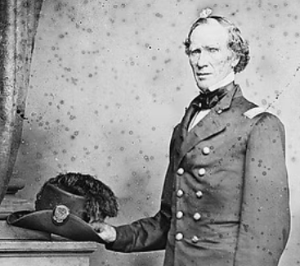
James C. Cameron, the 61 year old brother of Lincoln’s Secretary of War Simon Cameron, was elected Colonel of the regiment. |
| June | Duty in the Defenses of Washington, D. C., attached to Mansfield’s Command, Department of Washington. The 79th was quartered at Georgetown College, then a tent camp on Maridian Hill. |
| Early July | The regiment crossed the Potomac into Virginia singing “Blue Bonnets are Over the Boarder.” They Bivouacked at Camp Weed and were attached to Sherman’s Brigade, Tyler’s Division, McDowell’s Army of Northeast Virginia. |
| July 16-21 | Advance on Manassas, Virginia. |
| July 17 | Occupation of Fairfax Court House |
| July 21 |
Battle of Bull Run (Manassas)Sherman’s Brigade crossed Bull Run at Farm Ford and marched south, then pursed withdrawing Confederates down Matthews Hill to the base of Henry Hill. The watched the 2nd Wisconsin Infantry in their grey militia uniforms take heavy casualries in a failed attempt to attack Confederates who had overrun two Union batteries on top of the hill, drawing fire from both sides. The regiment lost 41 men killed or mortally wounded, 7 officers and 35 men wounded, and 8 officers and 107 men missing. Colonel James Cameron and Captain Brown were killed. Lieutenant Colonel Samuel Elliott’s horse was killed and fell on him, injuring him so badly he lost much of the use of his legs; Elliott would be forced to resign. |
| August | Duty in the Defenses of Washington assigned to W. F. Smith’s Brigade, Division of the Potomac.
|
| August 14 | The 79th New York mutinied. The regiment was angry that they were employed all day in pick and shovel work building fortifications. They were angry about not being allowed to elect their Colonel as was the custom in militia units, and the fact that officers could resign their commissions and leave while enlisted men did not have that right. Regimental discipline was damaged because they had lost so many officers in so short a time through casualties and resignations: Colonel Cameron, Lieutenant Colonel Samuel Elliott, the major, nine of the regiment’s 10 captains and a large number of lieutenants. Finally, with the assistance of alcohol, the men put down their tools and refused to work.
The response was quick. Major General McClellan sent Major George Sykes with a battalion of Regular infantry, a squadron of Regular cavalry, and a battery of Regular artillery, accompanied by Brigadier General Fitz John Porter. The Regulars lined up facing the mutineers with orders to fire if necessary. The mutineers were unprepaired for this response; they had no idea of the severity of their crime and their weapons were stacked. They were ordered to immediately surrender. The 79th’s regimental colours were to be taken away and would be kept at McClellan’s headquarters until the regiment redeemed itself. A single man to the rear shouted “Let’s keep the colors, boys!” and Major Sykes spurred his horse over to see who said it. Whoever it was had the wisdom to say no more and no one else joined him. Twenty-one members of the 79th who were thought to be the ringleaders were sentenced to the military prison at Fort Jefferson, Florida, on the Dry Tortugas. |
| September 25 | Reconnaissance to Lewinsville, Virginia. |
| October | Colonel Stevens was promoted to brigadier general and the regiment was assigned to Stevens’ Brigade, Smith’s Division, Army of the Potomac. Lieutenant Colonel Elliott and Major McClelland both resigned. |
| October 10-11 | Reconnaissance to Lewinsville, Virginia. |
| October 10 | Little River Turnpike, near Lewinsville |
| October 12 |
Bailey’s Cross Roads |
| October 21-November 7 |
Sherman’s Expedition to Port Royal, South CarolinaAssigned to Stevens’ 2nd Brigade, Sherman’s South Carolina Expeditionary Corps. Captain David Morrison of Company E was promoted to Major. |
| November 7 |
Capture of Forts Walker and Beauregard, Port Royal Harbor, South Carolina |
| November 8 to December 11 | Occupation of Bay Point |
| December-June | Duty at Beaufort, South Carolina and vicinity |
| December 17 | Lieutenant Colonel Addison Farnsworth of the 38th New York Infantry Regiment was promoted to colonel of the 79th. |
|
1862
|
|
| January | Expedition to Port Royal Ferry |
| April | Assigned to 2nd Brigade, 2nd Division, Department of the South |
| May 29 | Action at Pocotaligo, South Carolina |
| June 1-28 | Expedition to James Island, South Carolina |
| June 16 |
Battle of SecessionvilleThe regiment lost 1 officer and 34 men killed or mortally wounded, 5 officers and 74 men wounded, and 34 men missing. Lieutenant Colonel David Morrison was wounded. |
| June 28-July 7 | Evacuation of James Island and movement to Hilton Head, South Carolina |
| July 12-16 | Moved to Newport News, Virginia. |
| August 4-6 | To Fredericksburg and asigned to 2nd Brigade, 1st Division, 9th Corps, Army of the Potomac |
| August 13- September 2 |
Pope’s Campaign in Northern Virginia |
| August 13-27 | Operations on the Rappahannock and Rapidan Rivers |
| August 30 |
Second Battle of Bull Run (Second Manassas)The regiment lost 9 men killed or mortally wounded, 5 officers and 656 men wounded, and 1 officer and 12 men missing. Colonel Addison Farnsworth was badly wounded and disabled, and Lieutenant Colonel David Morrison took command of the regiment. |
| September 1 |
Battle of ChantillyBrigadier General Stevens (the regiment’s former Colonel) was killed after picking up the fallen colors of the regiment. Six color bearers had been shot down carrying it. Stevens’ son Hazard had been wounded moments before. The regiment lost 9 men killed, 79 wounded (one mortally) and 17 missing. |
| September 6-22 |
Maryland CampaignAssigned to 1st Brigade, 1st Division, 9th Corps, Army of the Potomac |
| September 14 |
Battle of South MountainThe regiment lost 12 men wounded. |
| September 16-17 |
Battle of Antietam (Sharpsburg)The regiment was commanded by Lieutenant Colonel David Morrison. It lost 8 men killed or mortally wounded and 2 officers and 22 men wounded. From the War Department marker for Christ’s Brigade along Rodman Avenue at Antietam:On the morning of the 17th Christ’s Brigade was in reserve on the eastern slope of the ridge on the left bank of the Antietam, nearly opposite the Burnside Bridge. About 2 P.M., after Sturgis’ Division had carried the bridge, the Brigade crossed and, following the stream and road to Sharpsburg, filed to the right where the course of the former diverged to the east and formed line on the narrow plateau at the foot of the bluff southeast of this point. After the formation of the Corps line, the Brigade advanced, under a heavy fire from Cemetery Hill and the high ground west of the road, to within a few yards of this point where it was checked. After a short delay the 79th New York advanced as skirmishers and compelled the Confederate Artillery to retire. The Brigade was about to move forward, when the attack of A.P. Hill on the left of the Corps obliged it to fall back to the Antietam, where it remained until the evening of the 18th, when it was relieved by Morell’s Division of the Fifth Corps. |
| September | Duty in Maryland |
| October 11- November 18 |
March up the Potomac to Leesburg, then to Falmouth, Virginia. |
| December 12-15 |
Battle of Fredericksburg |
|
1863
|
|
| January 20-24 |
“Mud March” |
| February 17 | Colonel Farnsworth was discharged for disability from his Second Bull Run wound. Lieutenant Colonel David Morrison was promoted to colonel. |
| March 13 | Moved to Newport News, Virginia. |
| March 20-28 | Transferred to Kentucky |
| April-June | Duty at Paris, Nicholasville, Lancaster, Stanford and Somerset assigned to the 1st Brigade, 1st Division, 9th Corps, Army of the Ohio |
| June 4-10 | Movement through Kentucky to Cairo, Ill. assigned to 3rd Brigade, 1st Division, 9th Corps, Army of the Tennessee. |
| June 14-17 | To Vicksburg, Mississippi. |
| June 17-July 4 |
Siege of Vicksburg |
| July 5-10 | Advance on Jackson, Mississippi. |
| July 10-17 |
Siege of Jackson |
| July 18-22 | Destruction of Mississippi Central Railroad at Madison Station |
| August 6 | At Milldale |
| August 6-12 | Moved to Crab Orchard, Kentucky. |
| August 16- October 17 |
Burnside’s Campaign in East TennesseeAssigned to 1st Brigade, 1st Division, 9th Corps, Army of the Ohio |
| October 10 |
Action at Blue SpringsThe regiment lost 12 men wounded, 2 mortally. |
| October | At Lenoir |
| November 4-December 23 |
Knoxville Campaign |
| November 16 |
Action at Campbell’s Station |
| November 17- December 4 |
Siege of Knoxville |
| November 29 |
Repulse of Longstreet’s assault on Fort SandersThe regiment provided about 120 men for the defence of Fort Sanders, which had a total of 250-450 men in its garrison. The Confederate assault made it to the walls of the fort before being thrown back in hand to hand fighting with disasterous losses. The Union loss was 20 killed and 80 wounded, of whom the 79th lost 4 men killed and 16 wounded. They Confederates lost 813 men, killed, wounded and missing. Longstreet abandoned taking Knoxville and eventually returned to Virginia to rejoin Lee’s army.
From Sergeant Judge’s citation: “The color bearer of the 51st Georgia Infantry (C.S.A.), having planted his flag upon the side of the work, Sgt. Judge leaped from his position of safety, sprang upon the parapet, and in the face of a concentrated fire seized the flag and returned with it in safety to the fort.” |
| December-March |
Operations in East Tennessee |
|
1864
|
|
| January 20 | Action at Holston River |
| January 21-22 | Strawberry Plains |
| January 20 | Action at Holston River |
| March | Moved to Annapolis, Maryland. |
| April | Assigned to 2nd Brigade, 3rd Division, 9th Corps, Army of the Potomac |
| May 3-June 15 |
Campaign from the Rapidan to the James |
| May 5-7 |
Battle of the Wilderness |
| May 8-21 |
Battle of Spottsylvania Court House |
| May 10 |
Ny River |
| May 12 |
Assault on the SalientThe original 79th New York fought its last engagement. It lost 5 men killed or mortally wounded. Colonel David Morrison was wounded, and Captain Laign took command of the remnants of the regiment. |
| May 13-15 | Non-Veterans – the men who had not reenlisted – left the front to guard prisoners to Alexandria, Virginia. The less than 130 men whose enlistments had not expired were formed into two companies, A & B, who guarded prisoners behind the lines. |
| May 23-27 |
North Anna River |
| May 28-31 |
Totopotomoy |
| May 31 | Non-Veterans moved to New York and mustered out under the command of Colonel Morrison. |
| June 1-12 |
Cold Harbor |
| June 1-3 |
Bethesda Church |
| June 16-18 |
Grant’s First Assault on Petersburg |
| June 16-18 |
Siege of Petersburg |
| July 30 |
Mine Explosion, Petersburg (Battle of the Crater) |
| August 18-21 |
Weldon Railroad |
| September | Assigned to 1st Brigade, 1st Division, 9th Corps |
| September 29-October 2 |
Poplar Springs Church |
| October | Assigned to Provost Guard, 9th Army Corps. Major Andrew D. Baird was in command. |
| October 27-28 |
Boydton Plank Road, Hatcher’s Run |
| November | The regiment reformed as the “New Cameron Highlanders.” The remaining men from the original regiment became Companies A and B, and two new companies, C & D, were formed of new volunteers. |
|
1865
|
|
| January | Company E was added from new volunteers. |
| March | Company F was added from new volunteers. |
| March 25 |
Fort Stedman |
| March 28-April 9 |
Appomattox Campaign |
| April 2 |
Fall of Petersburg |
| April 3 | Occupation of Petersburg |
| April 3-9 | Pursuit of Lee. Surrender of Lee and his army. |
| April 21-28 | Moved to Washington, D.C. |
| May 23 | Grand Review |
| June-July | Duty at Washington, D.C. |
| July 14 | The 79th New York Infantry Regiment mustered out. |
 Colonel Isaac I. Stevens (
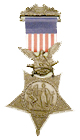 First Sergeant Francis W. Judge of Company K was awarded the Medal of Honor for his actions.